
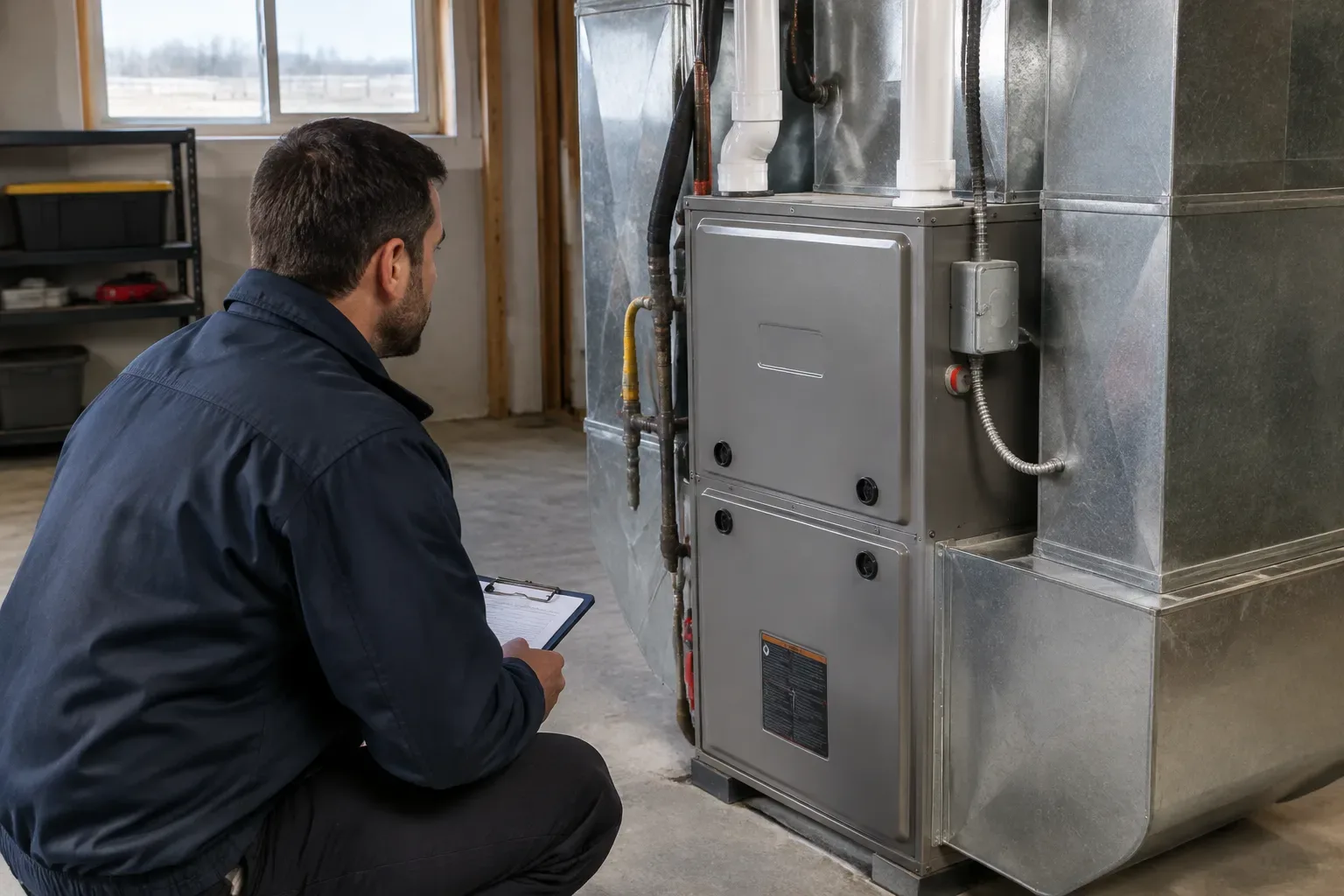
Why Is My Furnace Blowing Cold Air Even Though It Runs?
A furnace that runs but sends cold air through the vents may have a simple setting or airflow problem, such as the thermostat fan set to ON or a badly clogged filter. It can also be reacting to an ignition, safety-control, condensate, venting, or combustion fault. A brief burst of cool air at startup can be normal. Steady cold air after several minutes is not.
For Bennett-area households, the priority is restoring safe heat, especially when temperatures drop quickly. Eden Heating and Cooling provides HVAC service from Bennett throughout the Greater Denver area, but a few safe checks can help narrow down what you are seeing before arranging service.
Quick Answer
First, set the thermostat to HEAT, raise the setting above the current room temperature, and switch the fan from ON to AUTO. Then check the filter, open supply registers, and clear furniture or storage away from return grilles. If air remains cold, the system repeatedly starts and stops, or a fault code appears, turn to professional diagnosis rather than removing panels or bypassing safety devices.
For a gas furnace, never ignore a gas odor, soot, a carbon monoxide alarm, or symptoms such as headache, dizziness, nausea, or confusion. Leave the building and seek emergency assistance. The CDC explains that carbon monoxide is odorless and colorless and can cause sudden illness or death.
Is cool air at startup normal, or is there a problem?
The blower may begin moving air before the heat exchanger has fully warmed, so a short cool-air period at the beginning of a heating cycle can be normal. Some systems also run the blower briefly after the burners shut off to use remaining heat safely.
Sustained cold airflow is different. If the thermostat continues to call for heat and the vents stay cool, the equipment may be running only the blower, failing to light reliably, or shutting down on a protective control. The symptom alone does not prove which one is happening.
What can I safely check before scheduling furnace repair?
Keep these checks external and simple. Do not remove service panels, touch wiring, relight equipment, adjust gas components, or defeat a door switch or other safety interlock.
- Confirm the thermostat is on HEAT, set above room temperature, and not being overridden by a schedule, hold setting, dead battery, or loss of power.
- Set the fan to AUTO, then wait through one complete call for heat.
- Check the filter. Replace it if it is visibly loaded with dust or debris, using the correct size and type for the equipment.
- Make sure supply registers are open and return grilles are not blocked by rugs, furniture, or stored items.
- From outside, look for obvious leaves, snow, windblown dust, or debris around visible intake and exhaust terminations. Do not dismantle piping or vents.
- Check for a displayed fault code and write it down, along with unusual clicking, repeated starts, or the timing of the cold air.
A dirty filter can restrict airflow enough to cause overheating and protective shutdowns. The U.S. Department of Energy notes that maintenance, airflow, and combustion conditions affect furnace operation and efficiency in its furnace and boiler guidance.
Why does the blower run when the furnace is not heating?
The blower is a separate component from the heat-producing part of the system. That means you may hear the unit operating and feel air at the registers even though the burners or electric heating elements are not producing heat.
The table below separates common observations from possible causes. These are starting points, not confirmations. A technician must inspect the equipment to verify ignition, control-board, pressure-switch, limit-control, electrical, or combustion issues.
| What you notice | Possible explanation | What you can do safely | When professional diagnosis is needed |
|---|---|---|---|
| Air is cool only briefly at cycle start | Normal warm-up delay or blower run-on | Wait through a full heating cycle | It remains cold after the unit should be heating |
| Blower runs constantly, even between calls for heat | Fan set to ON, thermostat/control issue, or a safety response | Set fan to AUTO and review thermostat settings | The blower continues or the thermostat appears unresponsive |
| Furnace clicks, tries to start, then blows cool air | Failed ignition sequence, flame-sensing issue, gas-supply issue, or control fault | Record the sounds and any fault code | After repeated failed attempts or any gas-related concern |
| Unit heats briefly, then turns cool | Airflow restriction, limit-control shutdown, flame-proving issue, or venting/condensate problem | Check filter, registers, and obvious exterior obstructions | The cycle repeats or indoor temperature falls |
| Only a few rooms have cold airflow | Closed registers, duct leakage, zoning, balancing, or restricted airflow | Open registers and uncover returns | Other rooms heat normally but the affected rooms do not |
Could the thermostat or filter really cause cold air?
Yes, but they are not the only explanations. A thermostat with the fan set to ON can make a working heating system seem broken because it continues circulating unheated air. A weak thermostat battery, a programmed schedule, or a control problem can also interrupt a heat call.
A dirty filter is another plausible cause, particularly if the system starts heating and then stops. Restricted airflow can cause the equipment to overheat and open a safety limit. Once the blower cools the unit, the cycle may repeat. Replacing a visibly dirty filter is reasonable, but repeatedly cycling after a clean filter points to a problem that should be inspected.
What does it mean if a gas furnace ignites and then shuts off?
A gas furnace follows a sequence: the thermostat calls for heat, the unit performs safety checks, ignition begins, and the flame must be proven before the system continues heating. If that sequence fails at any point, the furnace may stop producing heat while the blower continues or restarts.
Possible causes include a dirty or failed flame sensor, an igniter problem, a pressure-switch or venting issue, a condensate safety shutdown, gas-supply trouble, or a control-board fault. These require hands-on testing. Do not clean burners, alter venting, or bypass safety switches as a troubleshooting shortcut. For persistent ignition or shutdown symptoms, arrange professional furnace repair.
Do high-efficiency furnaces have different cold-air causes?
They can. High-efficiency units often use plastic intake and exhaust piping and produce condensate during normal operation. A blocked condensate drain or a triggered condensate safety switch can prevent heating, while an obstructed combustion-air intake or exhaust can interrupt the operating sequence.
Wind, blowing dust, and seasonal debris can collect around exposed outdoor terminations on Colorado's eastern plains. Look only for clear, visible obstruction around the exterior opening. Do not take apart the vent or drain system. Colorado's high-plains elevation also makes correct combustion setup important, which is work for a qualified technician rather than a homeowner adjustment.
What if the system is actually a heat pump, not a furnace?
Not every forced-air system is a conventional gas furnace. A heat pump moves heat rather than creating it through combustion, and a dual-fuel system may switch between a heat pump and furnace. During a defrost cycle, airflow and sounds can differ from normal heating, and a thermostat or auxiliary-heat control issue may affect comfort.
Check the thermostat mode and identify the equipment type before assuming a burner problem. If the outdoor unit is part of the heating system and the home is not warming, an AC repair assessment may be relevant because the same outdoor equipment often handles cooling and heat-pump heating. If repair is no longer practical, system installation options can help frame a replacement discussion without assuming replacement is the answer.
When is cold air from only some vents a ductwork problem?
If most registers deliver warm air but one area stays cold, the heating equipment may be making heat normally. The issue could instead involve a closed or blocked register, a disconnected or leaking duct, zoning controls, return-air limitations, or airflow balancing.
Start by opening registers and clearing returns. Avoid closing numerous registers to force heat elsewhere, because that can create airflow problems at the equipment. If several rooms are uneven, describe which areas are affected and whether the rest of the home heats normally when requesting broader HVAC services.
When should I stop troubleshooting and turn the system off?
Stop using the system and seek emergency help if you smell gas, see soot, see flames outside the normal burner area, hear a carbon monoxide alarm, or suspect carbon monoxide exposure. The EPA's carbon monoxide guidance explains why fuel-burning appliances require proper venting and why CO detection matters.
For non-emergency problems, stop DIY troubleshooting when basic thermostat, filter, register, and visible exterior-vent checks do not restore heat. Repeated short cycling, failed ignition, unusual electrical behavior, fault codes, and steady cold air need a professional finding. The common mistake is repeatedly resetting the unit or bypassing a safety control, which can hide a developing fault rather than solve it.
What information should I have ready for the technician?
Useful details can shorten the diagnostic conversation without asking you to diagnose the equipment yourself:
- Thermostat mode, temperature setting, and fan setting
- Whether the air is always cold or turns cold after starting warm
- Whether the blower runs continuously
- Any fault code, flashing light pattern, or unusual sound
- Filter condition and the date it was checked
- Whether every room is affected or only selected vents
- Whether the system is a gas furnace, electric furnace, heat pump, or unknown
The practical takeaway is simple: verify the thermostat, filter, and airflow basics, then treat ongoing cold air as a service issue rather than a problem to solve by opening the furnace.
Ready to discuss your project?
If your Bennett-area system keeps running but the air stays cold, Eden Heating and Cooling can help identify the cause safely.
FAQ
Is it normal for my furnace to blow cold air before it gets warm?
A short burst of cool air can be normal while the heat exchanger warms and before the blower reaches its normal operating point. Cool air can also occur briefly after a heating cycle while the blower clears remaining heat. If airflow stays cold for several minutes while the thermostat is calling for heat, or if the home temperature keeps dropping, that is not a normal startup delay.
Can a dirty furnace filter make the heat blow cold?
It can contribute. A loaded filter restricts return airflow, which may cause the furnace to overheat and shut off heat production on a protective limit while the blower continues moving air. Replace a visibly dirty filter with the correct size and type. If the pattern continues after that, there may be another airflow, limit-control, ignition, or equipment issue that needs testing.
Why is my furnace running but the house is still cold?
The sound of a running blower does not confirm that the unit is producing heat. The fan may be circulating room air, or the furnace may be attempting and failing an ignition sequence. Heat can also be produced but not reach every room due to airflow or duct problems. Note whether all vents are cold or only certain rooms, then share that detail with a technician.
Should I reset my furnace if it keeps blowing cold air?
One normal thermostat adjustment or power-cycle following the equipment instructions may be appropriate, but repeated resets are not a repair. They can temporarily clear a symptom while an ignition, airflow, venting, condensate, or control issue remains. Do not bypass safety switches or repeatedly restart a unit that has a gas odor, soot, fault code, or repeated failed ignition pattern.
What does it mean if my furnace starts, then shuts off after a few seconds?
That pattern can indicate a failed safety or ignition sequence, but it does not identify one part with certainty. A flame-proving issue, venting problem, pressure-switch condition, airflow restriction, control fault, or condensate-related shutdown may be involved. Because the equipment is cycling through safety controls, this is a good reason to schedule furnace repair service instead of trying to force it to run.
Why is one room cold when the rest of the house is warm?
If other rooms receive steady heat, the furnace may not be the source of the problem. Check whether the cold room's register is open and whether its return path is blocked. Duct leakage, disconnected ducts, zoning settings, insulation gaps, or an airflow-balancing issue can also affect one room. A technician can determine whether the issue is distribution-related or tied to equipment performance.
Can blocked exhaust pipes cause a furnace to blow cold air?
Yes, particularly on sealed-combustion or high-efficiency systems. An intake or exhaust obstruction can prevent normal safety checks and stop the heating cycle. From outdoors, you can look for obvious debris, snow, or buildup around accessible vent openings. Do not remove vent sections or reach into the piping. Repeated shutdowns after a visible obstruction is cleared should be professionally checked.
How do I know if I have a heat pump instead of a furnace?
Look for an outdoor unit that operates during heating season, or check the thermostat for settings such as AUX HEAT, EM HEAT, or HEAT PUMP. Some homes have dual-fuel equipment, so both a heat pump and a furnace may be present. If the equipment type is unclear, share photos of the thermostat and equipment labels when requesting help so the diagnostic visit starts with the right system context.