
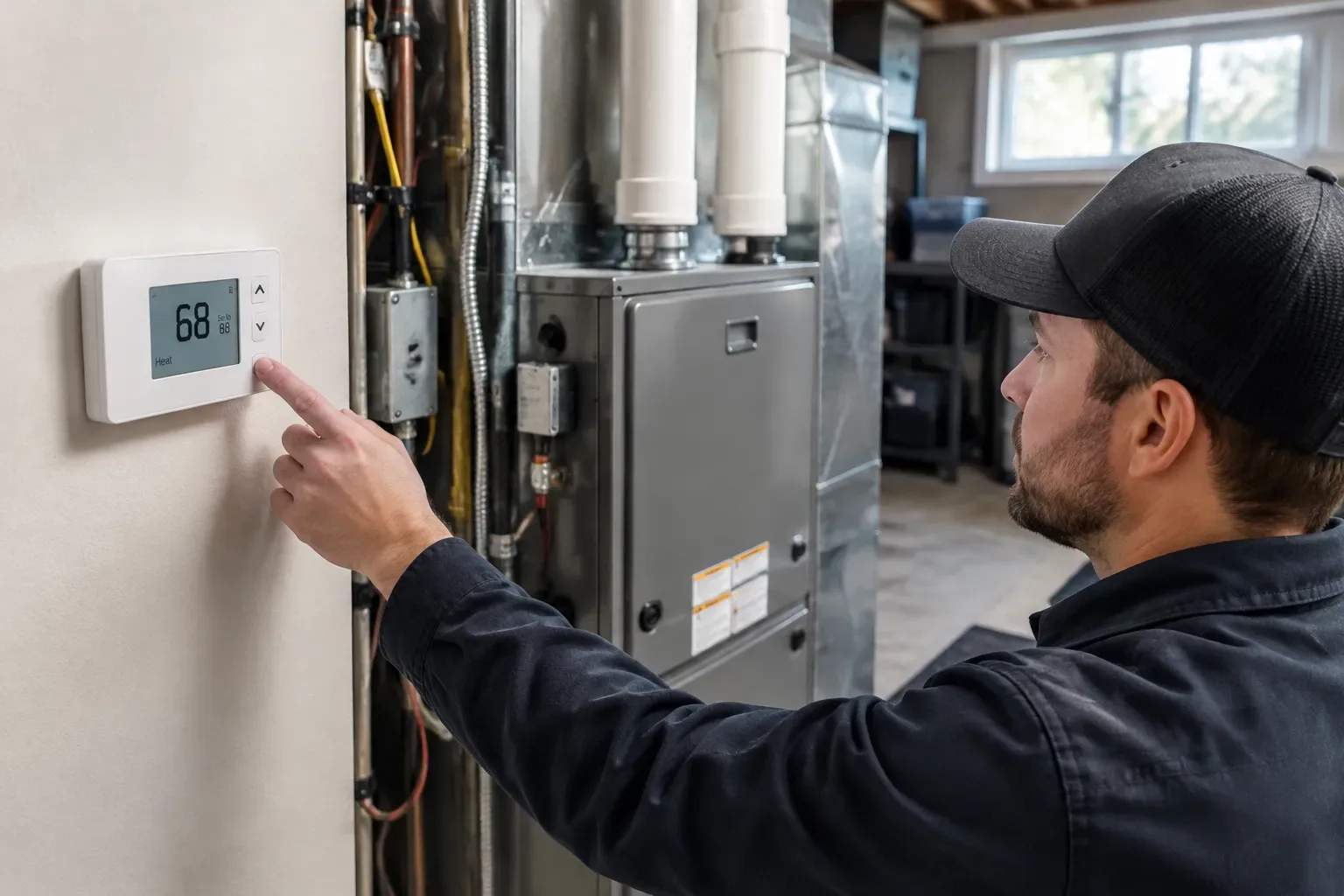
Can a Thermostat Cause a Furnace to Stop Working?
Yes. A thermostat can keep a furnace from starting if it has dead batteries, incorrect settings, a scheduling issue, damaged wiring, lost power, or an internal fault. But a thermostat is only one possible explanation for no heat. A furnace power issue, airflow restriction, ignition failure, safety lockout, or failed component can create similar symptoms.
For Bennett homeowners, the practical goal is to make a few safe checks, then avoid guessing or bypassing equipment controls. Eden Heating and Cooling provides HVAC service in Bennett and the Greater Denver area when the source of a heating problem needs professional diagnosis.
Quick Answer
A thermostat can stop a furnace from working by failing to send a call-for-heat signal. Start by confirming the thermostat is set to Heat and set above the current room temperature. If it uses batteries, replace them. Also check any schedule, temporary hold, furnace breaker, and clearly labeled furnace service switch.
If the display says “Heat On” but the furnace does not start, that message shows the thermostat is requesting heat. It does not prove the thermostat, wiring, or furnace has successfully completed the heating sequence. A technician may need to test the low-voltage signal, control board, safety circuit, ignition sequence, and airflow.
How does a thermostat tell a furnace to run?
A thermostat senses indoor temperature and requests heat when the room falls below its setpoint. As the U.S. Department of Energy explains, thermostats control heating and cooling equipment through their temperature settings and programming. In a typical forced-air system, that request travels through low-voltage wiring to the furnace controls.
If that signal does not arrive, or if the furnace detects a condition that makes operation unsafe, the burners may not light. This distinction matters because replacing a thermostat will not correct a failed igniter, dirty filter, tripped safety circuit, or control-board problem.
Which symptoms point to the thermostat, and which may point to the furnace?
A symptom can narrow the possibilities, but it cannot confirm a diagnosis by itself. Use the table as a guide to what you observe and what a professional may need to inspect.
| What you notice | Possible thermostat-related cause | Other plausible cause | Safe first check |
|---|---|---|---|
| Display is blank | Dead batteries, lost thermostat power, loose wire, failed thermostat | Furnace power loss or blown low-voltage fuse | Replace batteries if applicable; check the breaker and service switch once |
| Thermostat says “Heat On,” but nothing starts | Failed thermostat, wiring issue, incompatible setup | Control-board issue, safety lockout, failed inducer or ignition component | Confirm Heat mode and setpoint; listen for any furnace activity without removing panels |
| Furnace starts and stops repeatedly | Poor thermostat location, loose wiring, temperature-sensing problem | Dirty filter, overheating, limit switch, venting, or combustion issue | Check the filter condition and make sure supply and return vents are open |
| Blower runs but air is cool | Thermostat fan setting or configuration issue | Ignition failure, safety lockout, or burner problem | Set fan to Auto and note whether heat ever begins |
| House never reaches the set temperature | Inaccurate thermostat reading or programming | Furnace capacity, airflow, duct, insulation, or equipment issue | Compare the displayed temperature with room conditions and check the filter |
What thermostat checks are safe to do yourself?
Keep basic troubleshooting limited to settings, accessible power checks, and observations. Do not remove furnace access panels, touch internal wiring, or try to force the system to run.
- Set the thermostat to Heat and raise the setpoint several degrees above the displayed room temperature.
- Check for a schedule, vacation mode, temporary hold, or other programmed setting that may override the desired temperature.
- If the thermostat uses replaceable batteries, install the correct new batteries and verify the display returns.
- Check the furnace breaker and the clearly labeled furnace service switch if they are safely accessible. Do not repeatedly reset a breaker that trips.
- Check the air filter. A visibly dirty filter can restrict airflow and contribute to furnace shutdowns.
- Note what happens next: blank display, clicking, inducer or blower activity, fault-code lights, or no response at all.
Those details help narrow the issue if you need professional furnace repair. They are more useful than repeatedly changing settings or cycling power.
Why does the thermostat say “Heat On” when the furnace is not running?
“Heat On” usually means the thermostat has decided the home needs heat and is asking the system to provide it. It does not mean the furnace has power, accepted the signal, passed all safety checks, ignited successfully, or produced heat.
The furnace has its own sequence after receiving that request. Depending on the equipment, it may start an inducer, verify pressure and safety circuits, ignite, sense flame, and then start the circulating blower. A problem at any point can stop the cycle. That is why the thermostat display alone cannot separate a thermostat fault from a furnace fault.
Can dead thermostat batteries stop a furnace?
They can, particularly on battery-powered thermostats. Weak or dead batteries may leave the display blank, cause erratic behavior, or prevent a reliable call for heat. However, many thermostats are powered by the HVAC system and may not have replaceable batteries at all.
A blank display also may result from lost furnace power, a blown low-voltage fuse, loose thermostat wiring, or a failed thermostat. Replace batteries if your model uses them, but do not treat a blank screen as proof that batteries are the only issue.
Can a thermostat cause a furnace to short cycle?
Sometimes. Thermostat placement near a heat source, direct sunlight, a draft, or a supply register can make it sense the wrong room temperature. Loose wiring, poor configuration, or an incompatible replacement can also lead to erratic calls for heat.
Still, short cycling often has causes inside the heating system, including overheating from restricted airflow or a safety-control issue. Check the filter and open vents, then arrange a diagnosis if the repeated starts and stops continue. Repeated cycling is hard on equipment and can leave rooms unevenly heated.
When is the thermostat probably not the real problem?
A thermostat becomes less likely when the display and settings appear normal, but the furnace starts and then fails later in its sequence. For example, an inducer may run without ignition, burners may light and shut off quickly, or the blower may run with no heat. Those are observable symptoms, not a final diagnosis.
The actual finding may involve ignition, flame sensing, a limit control, airflow, a control board, or another furnace component. In some homes, a power-supply issue or an electrical problem outside the HVAC equipment may also be involved. A thermostat replacement in these situations can add cost without restoring heat.
When should you stop troubleshooting and request help?
Stop immediately if you smell gas, hear a carbon monoxide alarm, see scorch marks, or have a breaker that keeps tripping. Leave the home if there is a gas odor or carbon monoxide alarm, then follow local emergency guidance and contact the gas utility or emergency services as appropriate. Do not continue troubleshooting indoors.
For a no-heat issue without those emergency signs, request help when the safe checks do not restore operation, the furnace repeatedly shuts down, or the cause is unclear. During cold periods in eastern Colorado, it is sensible to arrange diagnosis promptly rather than repeatedly cycling controls and hoping the system resets.
What should you tell an HVAC technician before a furnace visit?
A clear description can make diagnosis more efficient. Record the thermostat setting and room temperature, whether the display is blank, whether the furnace makes any sound, whether the blower runs, whether the issue is intermittent, and whether there is a visible fault code. Also note when the filter was last checked.
Eden Heating and Cooling offers heating, cooling, maintenance, cleaning, and indoor-air-quality work through its HVAC services. The right repair path depends on confirmed findings, not on assuming the thermostat is at fault.
The practical takeaway
Start with thermostat mode, setpoint, batteries, schedule, accessible power, and filter condition. If those checks do not bring back heat, do not bypass controls or replace parts by guesswork. A proper diagnosis should verify both the thermostat signal and the furnace response.
Ready to discuss your project?
If your thermostat calls for heat but the furnace will not respond, Eden Heating and Cooling can help identify the cause in Bennett.
FAQ
Can a bad thermostat make a furnace not turn on at all?
Yes. A failed thermostat, dead batteries, incorrect Heat mode, a schedule override, or damaged low-voltage wiring can prevent a call for heat. The same no-start symptom can also come from a tripped breaker, furnace switch, control-board fault, ignition problem, or safety lockout. The useful first step is confirming settings and power, then having the signal and furnace sequence tested if heat does not return.
Why is my thermostat blank and my furnace not working?
A blank thermostat can be caused by dead batteries if the model uses them. It can also indicate lost power to the furnace, a low-voltage fuse issue, loose wiring, or a failed thermostat. Replace batteries where applicable and check the accessible breaker and furnace switch once. If the screen stays blank, avoid opening the equipment and arrange professional diagnosis.
Should I replace my thermostat if the furnace says it is not getting a signal?
Not automatically. A missing signal can originate at the thermostat, but it can also involve thermostat wiring, a connection, a low-voltage fuse, or the furnace control board. Replacing the thermostat before testing the circuit may not solve the problem. A technician can determine whether the thermostat is sending the call for heat and whether the furnace is receiving it.
Can the thermostat work for AC but not heat?
Yes. Cooling and heating use different control functions, so a thermostat may appear to operate the air conditioner while a heating setting, wiring connection, configuration issue, or furnace-side fault prevents heat. If cooling also behaves unpredictably, AC repair can help evaluate the broader HVAC controls and equipment response.
Is it safe to reset my furnace breaker?
You can check whether the breaker is tripped and reset it once if it is safe to access. Do not keep resetting a breaker that trips again. Repeated trips can indicate an electrical or equipment problem that needs inspection. Also check the clearly labeled furnace service switch, which can be bumped off accidentally, but do not remove panels or handle internal electrical components.
Why does my furnace blower run but there is no heat?
The fan may be set to On rather than Auto, or the furnace may be unable to complete ignition while still operating the blower. A dirty filter, safety shutdown, ignition failure, or control issue can also be involved. Set the fan to Auto, confirm the filter is not blocked, and note whether burners ever ignite. Cool airflow alone does not prove a thermostat failure.
Can a new thermostat be incompatible with my furnace?
It can. Some replacements need correct wiring, configuration, power arrangements, and compatibility with the heating system. An incorrectly installed or configured unit may display normally but fail to call for heat correctly. If you are considering a larger HVAC update that includes control compatibility, review AC installation and replacement options as part of planning, rather than assuming a thermostat alone resolves every system issue.
How do I know if I need furnace repair instead of a thermostat replacement?
You need a diagnosis when safe setting, battery, power, and filter checks do not restore heat, or when the furnace begins a cycle but fails before producing warm air. A technician can test the call-for-heat signal and inspect the furnace sequence, airflow, ignition, and safety controls. That process identifies the failed component instead of treating a thermostat replacement as a guess.