
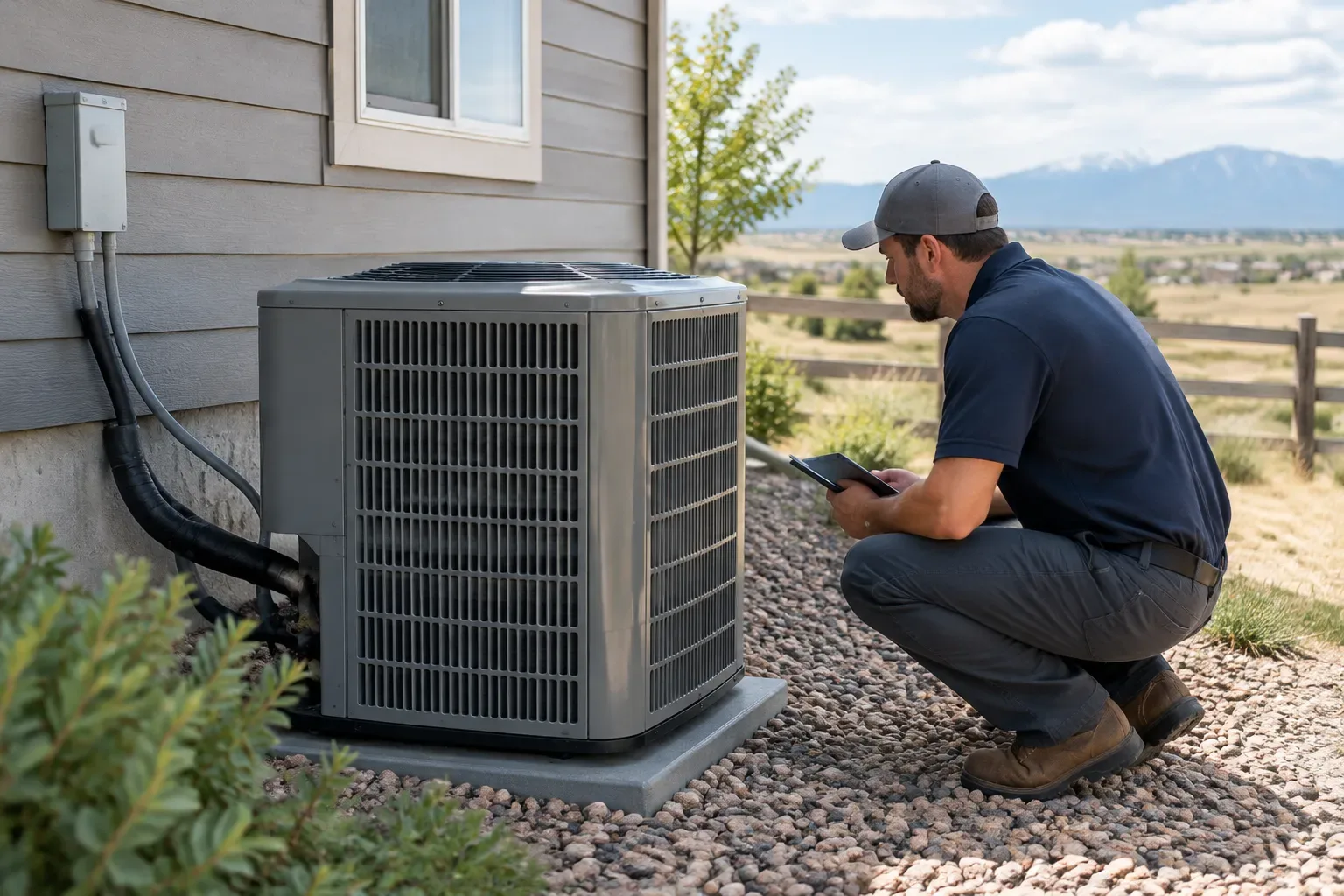
Why Is My Air Conditioner Running but Not Cooling the House?
An air conditioner can run without cooling because airflow is restricted, a coil is frozen or dirty, the outdoor unit is not doing its part, or an electrical, thermostat, drainage, refrigerant, or compressor issue is present. The symptom alone cannot identify the failed part, but a few safe checks can rule out simple settings and airflow problems.
For Bennett and Greater Denver households, dust, wind, outdoor debris, and intense sun can make airflow and condenser condition especially worth checking. If basic checks do not restore cooling, Eden Heating and Cooling can help determine what the system is actually doing before a repair or replacement decision is made.
Quick Answer
First, confirm the thermostat is set to COOL, the temperature setting is below the room temperature, and the fan is set to AUTO. Then check the filter, open supply registers and return grilles, and look at the outdoor unit from a safe distance for leaves, grass, trash, or heavy dust.
If air is warm, airflow is weak, ice is present, the outdoor unit is silent, a breaker trips again, or water is collecting near the indoor equipment, stop changing settings and arrange a diagnosis. Those observations point to several possible causes, not one certain failure.
What does the symptom you notice usually mean?
The pattern matters more than the fact that the system is running. These common observations can help you describe the issue accurately, but only an inspection can confirm the cause.
Weak air from several vents
A dirty filter, blocked return, closed registers, blower trouble, or a frozen indoor coil can restrict circulation. The house may feel warm even if the equipment is still operating.
Normal airflow, but the air feels warm
The thermostat, outdoor condenser, refrigerant circuit, or compressor may not be operating correctly. Duct leakage or inadequate insulation can also reduce delivered comfort.
Indoor unit runs, but the outdoor unit does not
A control, capacitor, motor, disconnect, breaker, or other electrical issue may be involved. Do not open electrical panels to investigate.
Ice on a refrigerant line or indoor equipment
A frozen evaporator coil is a symptom, not proof of low refrigerant. Restricted airflow, a dirty coil, or a blower problem can create the same result.
The U.S. Department of Energy notes that air-conditioning performance relies on proper airflow, clean components, and regular maintenance. Its air-conditioning guidance is a useful reminder that a system can lose cooling capacity without being completely off.
What can you safely check before scheduling service?
Avoid dismantling equipment, touching wiring, or removing access panels. Start with the checks that can reveal an obvious setting or airflow issue without creating a safety risk.
- Set the thermostat to COOL, lower the setpoint below the current room temperature, and set the fan to AUTO. Give the system time to respond rather than changing settings repeatedly.
- Inspect the HVAC filter. Replace a visibly dirty filter with the correct size and a compatible type for the equipment.
- Make sure supply registers and return grilles are open and clear of furniture, rugs, and accumulated dust.
- From a safe distance, check whether the outdoor condenser is running and whether its exterior is blocked by grass, leaves, trash, or dust. Do not spray electrical components or remove covers.
- Look for visible ice, water near the indoor unit, burning smells, unfamiliar electrical sounds, or a breaker that has tripped. Record what you see instead of repeatedly restarting the system.
A neglected or overly restrictive filter can reduce airflow enough to contribute to icing. ENERGY STAR maintenance guidance also identifies filters, coils, and airflow as important maintenance areas.
Could a dirty filter really stop an AC from cooling?
Yes, it can contribute, especially when airflow is already marginal. The indoor evaporator coil needs a steady flow of warm household air across it to absorb heat. If airflow drops substantially, the coil can become cold enough to freeze, further restricting airflow and reducing cooling.
A dirty filter is not the answer to every cooling problem. Replacing it may help if it is visibly loaded with dust, but it will not fix a failed capacitor, refrigerant leak, damaged blower, thermostat fault, or compressor problem. If the new filter does not restore normal performance, further diagnosis is appropriate.
Why would the AC blow warm air while both units appear to run?
The indoor blower and outdoor condenser can both make noise while the refrigeration cycle is not moving heat properly. Possible causes include a dirty outdoor coil, incorrect control operation, a weak electrical component, a refrigerant issue, or a compressor problem.
High-plains dust and wind can leave debris on the outside condenser coil. That coil releases heat outdoors, so blocked airflow there can reduce the system's ability to cool the house. Direct summer sun can also make long run times more likely, but sun exposure alone does not explain air that stays warm or a home that never approaches the thermostat setting.
What should you do if the evaporator coil or refrigerant line is frozen?
Turn cooling off to prevent the system from continuing to run against ice buildup. Do not chip or scrape ice away. Check the filter and visible airflow obstructions, then let the equipment thaw naturally. If the equipment manual permits fan-only operation, that setting may help move room-temperature air across the coil, but follow the manual for your specific system.
Call for service if ice returns, airflow stays weak after thawing, or cooling does not resume. A technician needs to distinguish between airflow restriction, blower trouble, a dirty coil, a refrigerant leak or incorrect charge, and other causes. Refrigerant is not a homeowner refill item: the EPA's refrigerant management requirements explain the federal rules that apply to refrigerant servicing.
Could a drain problem make the AC stop cooling?
It can. Cooling removes moisture from indoor air, and that water normally leaves through a condensate drain. A blocked drain, drain-pump issue, or safety switch may shut off part of the system or interrupt operation to limit overflow risk.
Dry conditions can make drainage clues less obvious than they are in a humid climate, so look for water around the indoor unit, an unusual lack of normal drainage when the system has been running, or a cooling cycle that stops unexpectedly. Water near equipment can also come from another source, so it should be inspected rather than assumed to be an AC drain problem.
When is it time to stop troubleshooting and call an HVAC technician?
Schedule professional AC repair and diagnosis when safe checks do not restore cooling, or right away if you notice a burning odor, persistent electrical noise, repeated breaker trips, severe ice, suspected oil or refrigerant residue, or water around indoor equipment. A technician can inspect thermostat operation, airflow, blower performance, coils, drainage, electrical components, ductwork, and the refrigerant circuit.
Some comfort issues may also be outside the air conditioner itself. Leaky ducts, insulation gaps, sun exposure through windows, or an undersized or poorly matched system can affect indoor temperature. Eden Heating and Cooling's HVAC services cover more than a single repair path, which matters when the inspection points to a broader comfort issue.
Is repair or replacement the better answer?
Neither choice is automatic. A repair may make sense when the fault is isolated, parts are available, and the rest of the system is performing well. Replacement can become more practical when repairs recur, the system has persistent comfort problems, important parts are unavailable, or an inspection finds a major failure alongside broader equipment concerns.
Ask for the equipment age, repair history, refrigerant type, efficiency condition, parts availability, and estimated scope of repair to be considered together. The common mistake is replacing equipment based only on one symptom, or approving repeated repairs without looking at the whole pattern.
What information should you have ready for an AC service visit?
A clear description helps narrow the diagnostic path. Note the thermostat setting and indoor temperature, whether air is weak or warm, whether the outdoor unit runs, the filter condition, visible ice or water, any odors or sounds, and recent maintenance or changes. If a breaker tripped, say whether it tripped once or again after being reset according to panel instructions.
For a system that has a confirmed major issue or ongoing reliability concerns, reviewing AC installation and replacement options is reasonable after the diagnostic findings are clear. The practical takeaway is simple: check settings and airflow first, then let the observed symptoms guide a proper inspection instead of guessing at the part.
Ready to discuss your project?
If your AC is running but the house is not cooling in Bennett or the Greater Denver area, Eden Heating and Cooling can help identify the cause.
FAQ
Why is my AC running all day but the house is still hot?
Long run time can be normal during very hot weather, especially with strong sun exposure. It becomes a concern when indoor temperature keeps rising, the system cannot get close to the setpoint, airflow is weak, or the supply air feels warm. Restricted airflow, a dirty outdoor coil, duct losses, refrigerant issues, or equipment faults are all possibilities. A thermostat reading alone cannot distinguish among them.
Can I keep running my AC if it is blowing warm air?
It is usually better to turn cooling off if the air remains warm after basic thermostat and filter checks. Continued operation may not improve comfort and can add strain if the system has an airflow, electrical, or compressor-related problem. Turn it off immediately if there is ice, a burning smell, unusual electrical noise, or repeated breaker trips. The indoor fan setting should follow your equipment manual.
Why is my outside AC unit running but my vents are not cold?
The outdoor unit may be operating without the system transferring heat effectively. Potential causes include a dirty condenser coil, a control or capacitor issue, restricted indoor airflow, a frozen coil, a refrigerant-circuit issue, or compressor trouble. Both units running only confirms that some components have power. It does not confirm correct airflow, refrigerant charge, or cooling capacity.
Can a furnace problem affect my air conditioning?
Yes. Many central systems use the furnace's indoor blower to circulate cooled air through the ducts. If that blower, its controls, or related airflow components have a problem, cooling may be weak even if the outdoor condenser runs. That does not mean the furnace is definitely at fault, but shared components are worth evaluating. See furnace repair information if the blower also behaves abnormally during heating season.
Is a frozen AC coil always caused by low refrigerant?
No. Low refrigerant is one possible cause, but dirty filters, blocked returns, a dirty indoor coil, closed registers, or blower problems can also reduce airflow and lead to freezing. Turning off cooling and allowing the coil to thaw is the safe first response. If ice returns, a technician needs to test airflow and the refrigerant circuit rather than assuming a leak.
Should I replace my air conditioner if it needs refrigerant?
Not necessarily. The useful question is why the refrigerant level is low and what the inspection finds. A leak may be repairable, but the repair decision should account for leak location, equipment condition, refrigerant type, repair history, parts availability, and overall performance. If replacement becomes the practical option, AC installation guidance can help you understand the next step.
What does it mean if water is leaking near my indoor AC unit?
It may point to a clogged condensate drain, a failed drain pump, a disconnected drain line, or ice melting from a frozen coil. It could also come from an unrelated plumbing or building issue. Avoid assuming the source based on water alone. Protect nearby belongings, avoid electrical hazards, and have the equipment inspected if the leak is active or cooling is interrupted.