
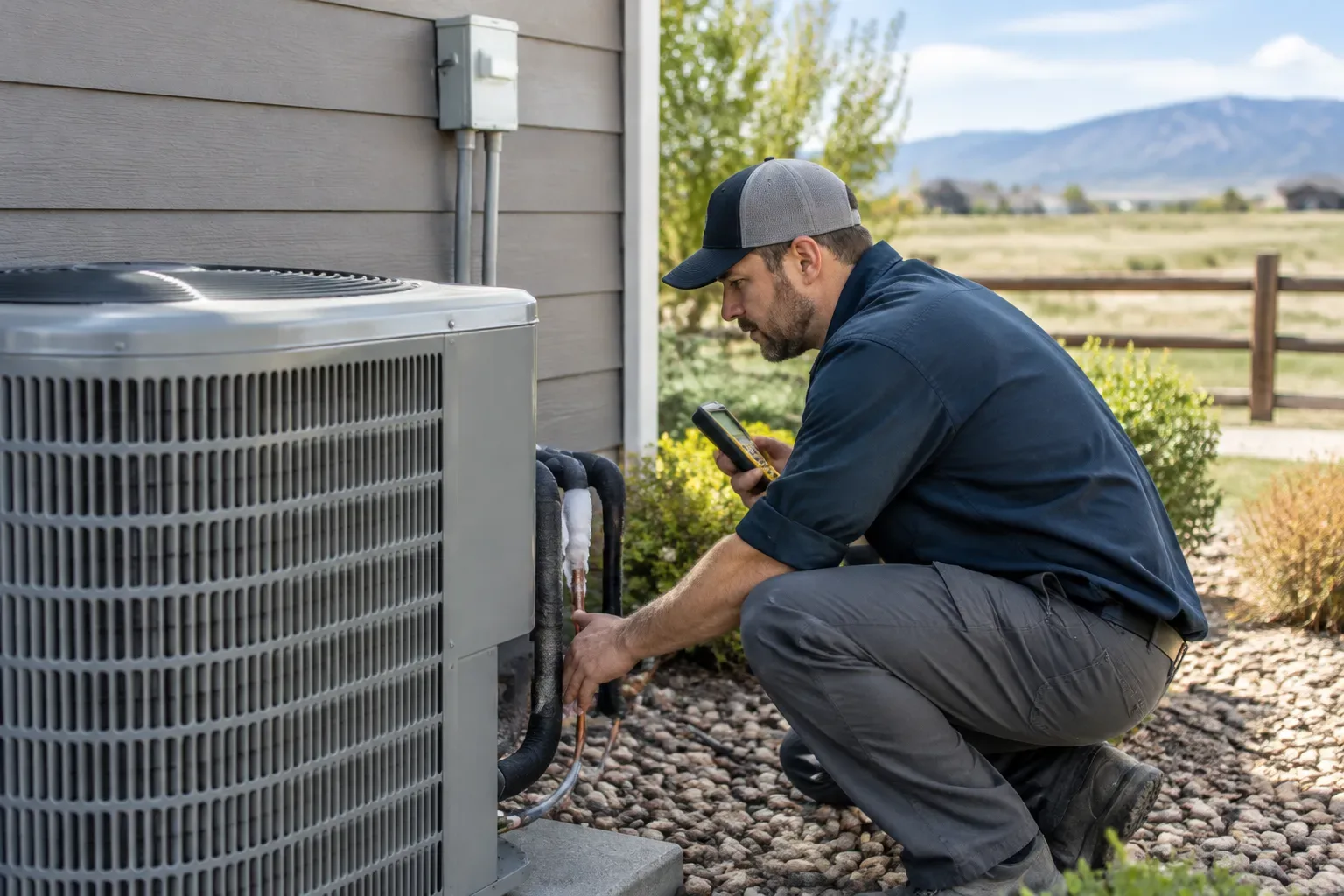
How Do You Know If an AC Refrigerant Leak Needs Immediate Attention?
An AC refrigerant leak needs prompt attention when cooling drops off, the system runs for long periods without reaching the thermostat setting, refrigerant lines or the indoor coil freeze, or you hear hissing near the equipment. Turn the AC off and arrange an inspection sooner if it is repeatedly icing, not cooling at all, or cycling through shutdowns. A burning smell, hot electrical odor, or other electrical symptom is a separate safety concern that warrants immediate action.
Not every warm room, puddle, or frozen coil proves there is a leak. Airflow restrictions, dirty coils, thermostat problems, drainage issues, and equipment faults can create similar symptoms. For homeowners in Bennett and the Greater Denver area, Eden Heating and Cooling can help distinguish a refrigerant issue from another AC problem.
Quick Answer
Schedule prompt HVAC service if your AC is cooling poorly, running constantly, making a hissing or bubbling sound, or developing ice. Shut the system off rather than continuing to cool if the indoor coil or refrigerant line is frozen, cooling has stopped, or the unit repeatedly shuts down. Do not add refrigerant yourself or treat a recharge as a permanent fix without finding the source of the loss.
Hotter Bennett days can make a partially charged system's weakness more obvious. It may seem adequate during mild weather, then run much longer and still struggle to hold the indoor temperature when cooling demand rises.
Which AC refrigerant leak symptoms deserve attention?
Refrigerant is the fluid that carries heat from inside the home to the outdoor unit. A sealed AC system should not need regular topping off, so a low refrigerant charge can point to a leak or another service issue that requires professional confirmation.
These are observable symptoms, not a diagnosis by themselves:
- Air from the vents feels less cool than usual, or rooms do not reach the thermostat setting.
- The AC runs much longer than normal or seems to run continuously during warm weather.
- Ice appears on the insulated refrigerant line outside or on the indoor evaporator coil.
- You hear a hissing or bubbling sound near refrigerant tubing, the indoor unit, or the outdoor unit.
- Electricity use rises while comfort falls.
- Airflow from vents seems weaker, especially if the coil has begun to freeze.
Poor cooling can also come from a clogged filter, a blower issue, duct leakage, a dirty outdoor coil, a thermostat fault, or a drainage-related shutdown. The U.S. Department of Energy notes that airflow and maintenance conditions affect air-conditioning performance, which is why proper AC operation and maintenance matter before assigning one cause to a symptom.
When should you turn the AC off instead of waiting?
A frozen coil is a clear point to stop normal cooling operation. Ice blocks heat transfer and can restrict airflow, so continuing to run the system can worsen performance and place additional strain on the compressor. The compressor is a major component that circulates refrigerant, and it is not something to gamble with based on a guess.
Use this urgency guide to decide what to do next.
Schedule service promptly
Cooling is weaker, run times are longer, or you hear intermittent hissing, but the system is still operating and there is no ice or safety concern. These signs should not be put off until the next routine visit.
Turn cooling off and arrange an inspection soon
The evaporator coil or refrigerant line is frozen, the AC is blowing warm air, or it repeatedly stops cooling. Letting a frozen system continue can create a bigger repair problem.
Treat it as a separate safety issue
You smell burning, see damaged wiring, notice smoke, or experience repeated electrical breaker trips. Turn the system off and seek qualified electrical or HVAC help immediately; these signs are not evidence of a refrigerant leak alone.
If the system is frozen, set cooling to off. Depending on the equipment and its condition, a technician may advise using fan-only mode to help thaw the coil, but do not use that as a substitute for diagnosis. Do not chip at ice, pull insulation apart, or handle refrigerant tubing unnecessarily.
Why is a refrigerant recharge not always the repair?
A recharge restores the amount of refrigerant in the system. It does not automatically correct why the charge became low. If refrigerant escaped through a leaking connection, coil, service valve, or accessible section of tubing, the temporary improvement can fade as the loss continues.
A complete service decision may involve locating the leak, evaluating whether repair is practical, making the appropriate repair, testing the circuit, removing moisture and air from it, and charging the equipment according to its requirements. Refrigerant handling is regulated work. The EPA outlines refrigerant leak repair requirements for covered stationary equipment, which is one reason DIY charging or refrigerant recovery is not a safe homeowner task.
For poor cooling, a focused AC repair assessment is the right starting point. It can determine whether a leak is actually present and whether another issue is producing similar symptoms.
What can you safely check before an HVAC visit?
You do not need to diagnose the refrigerant circuit to provide useful information. A few safe observations can make intermittent problems easier to evaluate, especially because large temperature shifts can change how severe the symptoms appear during the day.
- Turn cooling off if you see ice, have no cooling, or notice an electrical or burning smell.
- Check the air filter and replace it if it is visibly loaded and you have the correct replacement filter.
- Note the thermostat setting, indoor temperature, outdoor conditions, when the problem began, and whether the unit runs continuously or cycles off.
- Look without touching for ice on the refrigerant line, reduced airflow at vents, water around the indoor equipment, or unusual sounds.
- Tell the technician about any prior refrigerant work, repeated freezing, or recent changes in performance.
Avoid opening sealed equipment panels, using store-bought refrigerant products, or trying to seal a suspected leak. A puddle may be normal condensation, a blocked drain, or ice melting after shutdown. It does not identify a refrigerant leak by itself.
When does replacement make more sense than leak repair?
Repair is often sensible when the source is accessible and the rest of the system is in good condition. Replacement may be worth considering when the leak is in a difficult-to-repair location, the equipment has broader reliability concerns, the needed refrigerant is a poor fit for a major repair, or the expected repair scope is large relative to the system's remaining useful life.
Symptoms alone cannot make that decision. An inspection needs to establish the leak location, equipment condition, refrigerant requirements, and repair scope first. If replacement becomes the practical option, AC installation and replacement can be discussed after the diagnosis rather than assumed at the first sign of warm air.
What is the most common mistake after a frozen AC coil?
The most common mistake is restarting cooling as soon as the visible ice melts without addressing why it froze. A thawed coil can freeze again if low refrigerant, airflow restriction, blower trouble, or another underlying issue remains. Repeated icing can reduce comfort and make the original cause harder to judge from a single observation.
A better takeaway is simple: document what happened, keep the system off if it is frozen, and have the cause identified before returning it to normal cooling. Broader HVAC services may be needed when the inspection points to airflow, cleaning, controls, or another non-refrigerant issue.
Ready to discuss your project?
If your Bennett AC is freezing, running too long, or losing cooling, Eden Heating and Cooling can help identify the cause.
FAQ
Is a refrigerant leak an AC emergency?
Usually, a refrigerant leak is a prompt repair issue rather than a 24-hour safety emergency. It becomes more urgent when the system has no cooling during dangerous heat, freezes repeatedly, or will not stay running. Burning odors, smoke, damaged wiring, and breaker trips are different safety symptoms. Shut the unit down and seek immediate qualified help for those electrical concerns.
Can low refrigerant make my air conditioner blow warm air?
Yes, low refrigerant can reduce the system's ability to move heat, so supply air may feel less cool and the home may not reach the set temperature. Warm air does not prove a leak, though. A dirty filter, outdoor coil restriction, thermostat issue, or compressor-related problem can also affect cooling. An inspection separates the symptom from the confirmed cause.
Why is my AC line frozen outside?
A frozen insulated line can indicate that the indoor evaporator coil is becoming too cold, often because of low refrigerant or inadequate airflow across the coil. A clogged filter, blower problem, or dirty coil may contribute. Turn cooling off instead of trying to melt or scrape the ice, then have the system evaluated if freezing recurs.
Can I keep running my AC if it has a small refrigerant leak?
It is better not to ignore suspected refrigerant loss. The system may run longer, cool less effectively, and eventually freeze or stress key components. If there is no ice and cooling remains steady, schedule an assessment promptly rather than waiting for failure. If ice appears or performance falls sharply, stop cooling and arrange professional AC repair.
Can I add refrigerant to my home AC myself?
No. Homeowners should not attempt to charge, recover, or repair the sealed refrigerant circuit. Correct service requires appropriate equipment, procedures, and verification of the actual fault. Adding refrigerant without finding a leak can mask the problem temporarily and may leave air or moisture concerns unaddressed. Safe troubleshooting begins with observable symptoms and a qualified inspection.
How do technicians find an AC refrigerant leak?
The exact approach depends on the equipment and accessibility. A technician may inspect connections, coils, service valves, and accessible tubing, then use suitable leak-testing methods to confirm a source. The professional finding matters because a hissing sound, warm air, or ice cannot identify the leak location on its own. The repair plan should follow the confirmed condition.
Does an older AC with a leak always need replacement?
No. Age is one decision factor, not an automatic verdict. The location and repairability of the leak, overall equipment condition, refrigerant compatibility, and expected remaining service life all matter. If repair is no longer the practical path, an evaluation of AC replacement options can compare the next step without assuming that every leak requires a new system.
Could a heating problem be related to a refrigerant leak?
Not necessarily. In a conventional furnace and central AC setup, a furnace heating fault and an AC refrigerant issue are separate problems. A heat pump is different because it uses refrigerant for both heating and cooling. If your heating system is not producing heat, use a targeted furnace repair service assessment rather than assuming the AC diagnosis applies.