
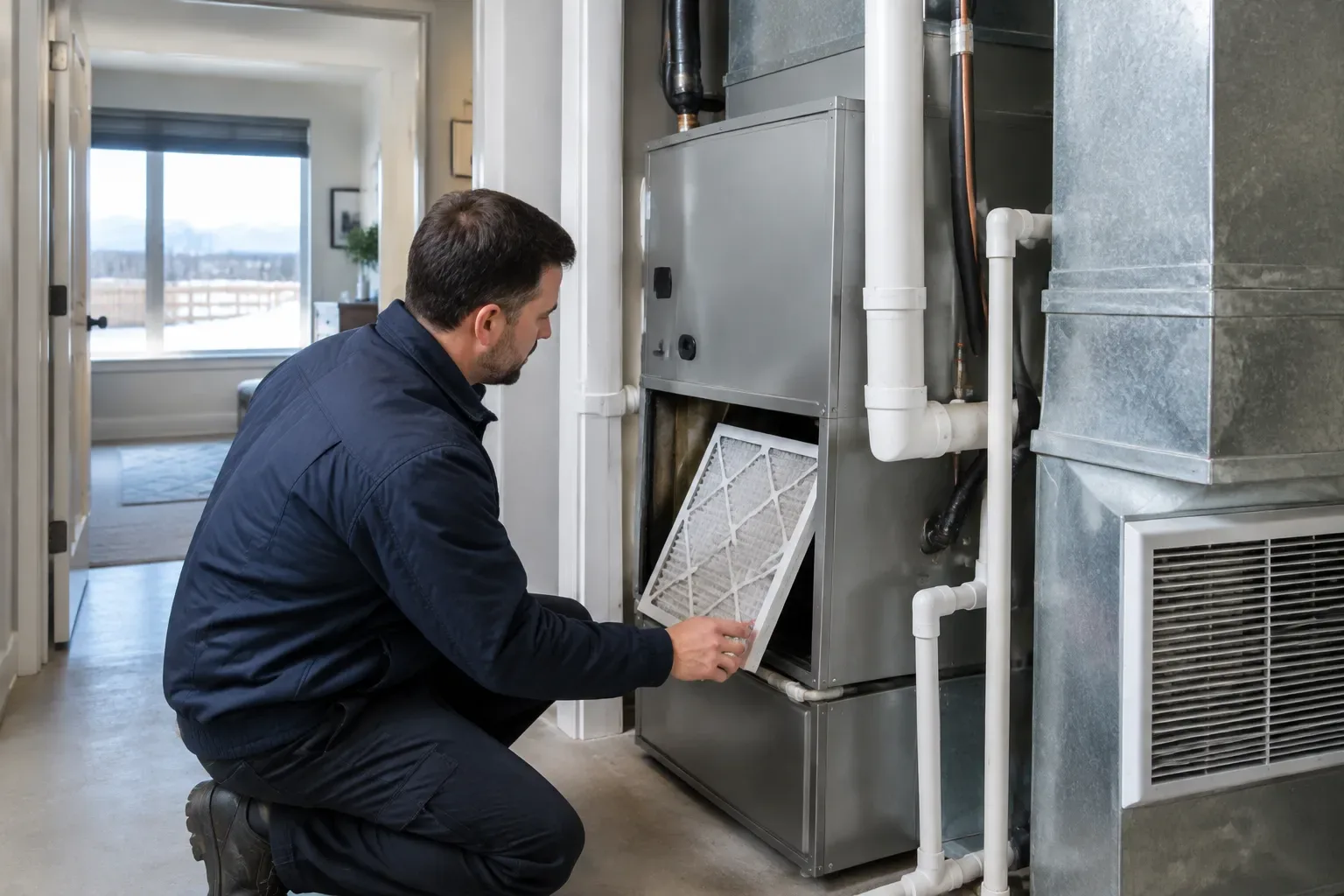
Why Is One Room Colder Than the Rest of the House?
One room can be colder because it receives too little warm air, loses heat faster than the rest of the house, or both. A blocked register, dirty filter, weak return-air path, duct issue, thermostat location, drafts, and insufficient insulation are all plausible causes. The symptom alone does not prove that the furnace has failed.
For Bennett-area households, cold and windy winter weather can make air leaks around exposed windows, doors, rim joists, and exterior penetrations especially noticeable. Eden Heating and Cooling helps homeowners sort out heating and cooling comfort concerns without assuming that equipment replacement is the first answer.
Quick Answer
Start by comparing the room's actual temperature with a nearby room using the same thermometer. Then check whether the supply register is open and blowing, whether the return grille is clear, whether the filter needs attention, and whether the room has obvious drafts.
Weak airflow points more toward a distribution or HVAC airflow issue. Strong warm airflow with a room that cools down quickly points more toward heat loss through windows, insulation gaps, or air leaks. A professional inspection can confirm the difference by measuring airflow and examining accessible equipment and duct conditions.
Is the cold room getting less warm air, or losing heat too quickly?
This is the most useful first distinction. Stand near the register while the heating system is running, then compare its airflow with a register in a comfortable room. Also note how the room feels near exterior walls, windows, and doors.
Low airflow or poor air delivery
A weak register, little air movement, or a room that worsens when its door is closed can point to a blocked register, return-air limitation, duct restriction, duct leakage, or system balancing issue.
Fast heat loss from the room
If the register delivers a normal amount of warm air but the room still feels chilly, drafts, window performance, insulation gaps, and exposure to unconditioned areas become more likely.
Thermostat or whole-system control issue
A thermostat in a warmer central area may satisfy the system before a distant room catches up. A dirty filter, blower problem, or other system-wide airflow restriction can make an existing imbalance more obvious.
Leaky or poorly connected ducts can reduce the conditioned air that reaches a room. The U.S. Department of Energy's duct-sealing guidance explains why sealing and insulating ducts can improve duct-system performance. That does not mean every cold room has a duct leak, but it is a worthwhile possibility when airflow is weak at the register.
What can you check safely before scheduling service?
A few simple observations can narrow the problem without taking apart HVAC equipment. Avoid opening furnace panels, altering gas components, or making duct changes yourself.
- Measure the cold room and a nearby comfortable room with the same thermometer after the system has been running long enough to stabilize. Record the difference and whether it changes at night, in wind, or with the bedroom door closed.
- Confirm that the room's supply register is fully open and not blocked by furniture, rugs, drapes, or stored items. Check whether air is actually moving while the furnace runs.
- Make sure the return grille is not covered by furniture or heavy dust. A closed door can limit return airflow in a room that has no dedicated return grille or transfer path.
- Check the HVAC filter according to the equipment and filter manufacturer's instructions. Do not assume a thicker, denser filter is automatically better for every system.
- Feel for drafts around windows, exterior doors, baseboards, outlets on exterior walls, and attic access points. Look for loose weatherstripping or visible gaps.
- Write down any furnace symptoms, such as unusual noise, repeated cycling, inconsistent operation, or reduced airflow in several rooms. These details help an HVAC professional evaluate the system efficiently.
Routine filter care and professional maintenance support reliable operation, as outlined in ENERGY STAR's heating and cooling maintenance guidance. Still, a fresh filter will not correct a poorly sized duct run, missing return path, or a drafty room.
Why does a bedroom get colder when the door is closed?
A closed bedroom door can create a pressure problem if the room has supply air but no clear route for air to return to the central system. Warm air enters through the supply register, but restricted return airflow can reduce circulation and make the room less comfortable.
This is more likely in rooms without a dedicated return grille. The professional finding might involve a missing or undersized return path, but the observable symptom is simpler: the room gets stuffier, colder, or has weaker airflow when the door is shut. Keeping the door open temporarily can be a useful test, not a permanent repair.
Could windows, insulation, or drafts be the real problem?
Yes. A room near an attic, garage, crawlspace, exterior wall, or unconditioned addition may lose heat faster than interior rooms. In Colorado's eastern-plains winter conditions, wind-driven leakage around exterior openings can make one exposed room feel noticeably colder even when the supply air is normal.
The Department of Energy's home air-sealing guidance identifies common leakage areas where unwanted air movement can increase heat loss. Low indoor humidity can also make a room feel less comfortable in Colorado's dry climate, but humidity alone does not explain a large temperature difference from room to room.
Insulation, windows, and air sealing may fall outside the scope of an HVAC repair. That is why separating a heat-loss issue from an airflow issue matters before investing in a heating-system solution.
Can ductwork or an addition cause uneven heating?
It can. Rooms added or remodeled after the original HVAC system may have a longer duct route, undersized ductwork, inadequate return airflow, or insulation and air-sealing conditions that differ from the original house. A converted garage or addition is not automatically the cause, but its design deserves attention during diagnosis.
HVAC comfort depends on more than equipment capacity. The ACCA technical standards address equipment selection, duct design, and airflow distribution, which is why simply installing a larger furnace is not a reliable cure for a single cold room. In some situations, duct correction or building-envelope improvements are more appropriate than equipment replacement.
When does uneven heating point to a furnace problem?
One cold room by itself often points first to airflow distribution or heat loss. However, furnace-related concerns become more likely when several rooms have reduced airflow, the system cycles repeatedly, temperatures vary throughout the house, or the furnace makes unusual noises.
A dirty filter, blower issue, or other airflow restriction can reduce delivered heat and magnify a room-to-room imbalance. If those symptoms are present, a furnace repair evaluation can help identify whether the issue is with the equipment, airflow, or both. Persistent imbalances in the Denver-area region may also warrant professional evaluation because equipment airflow and heating performance must be set up appropriately for the installation conditions.
What will an HVAC technician look for?
A proper visit is about evidence, not guessing from a thermostat setting. Depending on access and the symptoms, a technician may compare supply and return airflow, inspect accessible ductwork, assess static pressure, evaluate the blower and filter, and look for signs that the system is not distributing air as intended.
Static pressure is the resistance to airflow inside the duct system. If it is too high, the blower may struggle to move enough air, which can leave distant rooms underheated. A technician may also identify when the HVAC system appears to operate normally and an insulation, window, or air-sealing professional is the better next contact.
For broader heating, cooling, cleaning, and comfort support, review Eden's available HVAC services. If an inspection shows that an aging system truly is not suitable for the home's load and distribution needs, air conditioning installation and replacement options are a separate conversation, not a default answer to one cold room.
When should a cold room be treated as a safety concern?
Seek prompt professional help if uneven heating comes with fuel odors, a carbon-monoxide alarm, visible soot, repeated furnace shutdowns, unusual banging or booming sounds, or no heat. Leave the area and follow applicable safety guidance if a carbon-monoxide alarm activates or you suspect a gas-related hazard.
Portable space heaters are not a permanent fix for an underheated room. If one is used temporarily, follow its manufacturer instructions, keep it away from combustible materials, avoid overloaded circuits, and do not leave it unattended.
The practical next step for a consistently cold room
Do the simple airflow and draft checks first, then document what you find. The most productive fix comes from identifying whether the room is under-supplied, unable to return air, losing heat, or affected by a broader equipment issue. Replacing major equipment before making that distinction can leave the original comfort problem unresolved.
Ready to discuss your project?
If one room in your Bennett-area home stays cold, Eden Heating and Cooling can help you evaluate the airflow and heating symptoms.
FAQ
Can a blocked or closed vent make one room colder?
Yes. A closed, partly closed, or obstructed supply register can reduce the warm air entering that room. Check that furniture, rugs, curtains, and storage are not blocking the register. Also inspect the return grille, because a room needs a path for air to circulate back to the system. If the register is open but airflow remains much weaker than other rooms, the issue may be in the ductwork or system airflow rather than the register itself.
Why is the room farthest from my furnace always colder?
Distance can matter because a long duct run may lose heat or deliver less airflow, especially if the duct is poorly connected, uninsulated in an unconditioned area, kinked, or undersized. It is not proof that distance is the cause. Compare register strength with closer rooms, check for drafts, and have an HVAC professional inspect accessible ducts and airflow if the difference is consistent.
Can a dirty furnace filter make one bedroom colder than the others?
A dirty filter can restrict airflow across the whole system and make an existing comfort imbalance more noticeable. It is more likely to affect several rooms than only one bedroom. Replace or clean the filter only as directed for your equipment and filter type. If the rest of the house heats well but one room does not, investigate that room's register, return-air path, duct route, and heat loss too.
Why is my upstairs bedroom colder in winter?
An upstairs room may be affected by attic exposure, exterior-wall heat loss, duct runs routed through colder spaces, or return-air limitations. A strong draft near windows or ceiling edges suggests heat loss may be part of the problem. Weak air from the register suggests an airflow issue. If the room is part of a remodel or addition, its duct sizing and insulation may differ from the rest of the house.
Should I close vents in warm rooms to force more heat into a cold room?
Usually, no. Closing a single register slightly may change comfort in some homes, but closing multiple registers can raise duct pressure and reduce overall airflow. It is not the same as professional balancing. If you need to manipulate several vents just to make one room tolerable, an evaluation is more useful than ongoing trial and error. For cooling-season airflow concerns, AC repair guidance can also help you decide when a system check is appropriate.
Can thermostat location cause one room to stay cold?
Yes. A thermostat in a warm central room may reach its set temperature and stop the furnace before a distant, shaded, or drafty room warms fully. This is particularly noticeable in homes with open central living areas and closed bedrooms. Moving a thermostat is not always the answer, because the room may still have airflow or insulation problems. A diagnosis should address the underlying imbalance first.
Will a new furnace fix uneven heating in my house?
Not necessarily. A new furnace may help if the existing equipment has a confirmed operational or sizing problem, but it will not automatically fix leaky ducts, a blocked return, a long undersized duct run, poor insulation, or drafty windows. Before considering replacement, ask for an assessment of airflow distribution and room heat loss. A targeted repair may be the more effective solution.
Who can check why one room is colder in Bennett, CO?
An HVAC professional can evaluate the heating equipment, filter, blower performance, accessible ductwork, and airflow indicators. The visit may show that the system needs repair, or it may indicate that air sealing, insulation, window work, or a return-air improvement should be considered separately. Bringing notes about temperature differences, closed-door effects, and weak registers helps make the evaluation more focused.